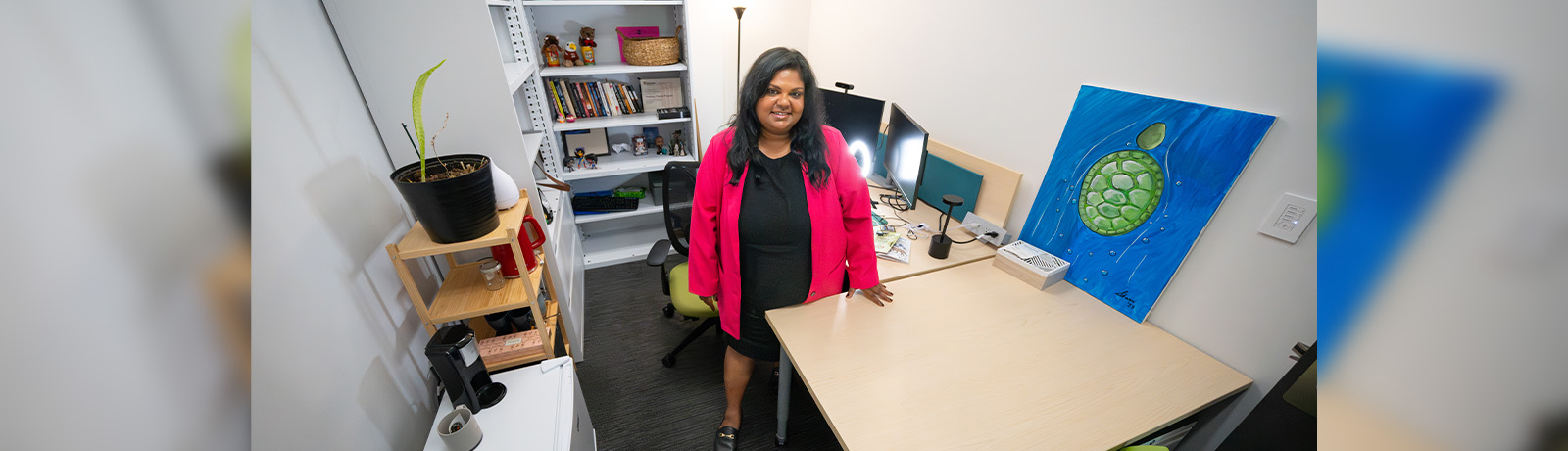
When stepping into Soni Dasmohapatra’s office in Allard Hall, visitors are greeted with soft lighting, soothing scents, student artwork and a cozy couch complete with a pillow and blanket. After being offered coffee or tea and a snack, it’s impossible not to feel welcome.
“I want students to feel like I'm accessible,” says the assistant professor in the Department of Arts and Cultural Management. “They can come and ask questions, delve into political discussions about the current state of art and culture management, or even talk about festivals that are happening. I try to nurture opportunities to expand discussion.”
That dedication and attention earned Dasmohapatra a 2025 Early Career Teaching Excellence Award. Drawing on experience from previous positions in public service, where she worked at all levels of government and even at the United Nations, she has a deep understanding of how cultural policy and politics interact.
Her experience as a member of the City of Edmonton’s Naming Committee often makes its way into her AGAD 301: Cultural Policy and Advocacy course where she shares that experience and knowledge with her students. In one session of the course, the class compared naming policies in Edmonton to those in other major cities like London and New York.
“They offered some recommendations for policy shift and change, and then they actually got a chance to formally present to the committee members,” says Dasmohapatra. “It was a really nice, interactive, municipal student-led interaction and exchange.”
And just as her passion for learning about Indigeneity and spirituality has been a part of her journey with that committee, it’s also something she encourages students to explore through class field trips to the Edmonton archives and the Indigenous Art Park.
“Going to these places lets them apply their learning so they can see it in a live context,” she explains.
Welcome to my office
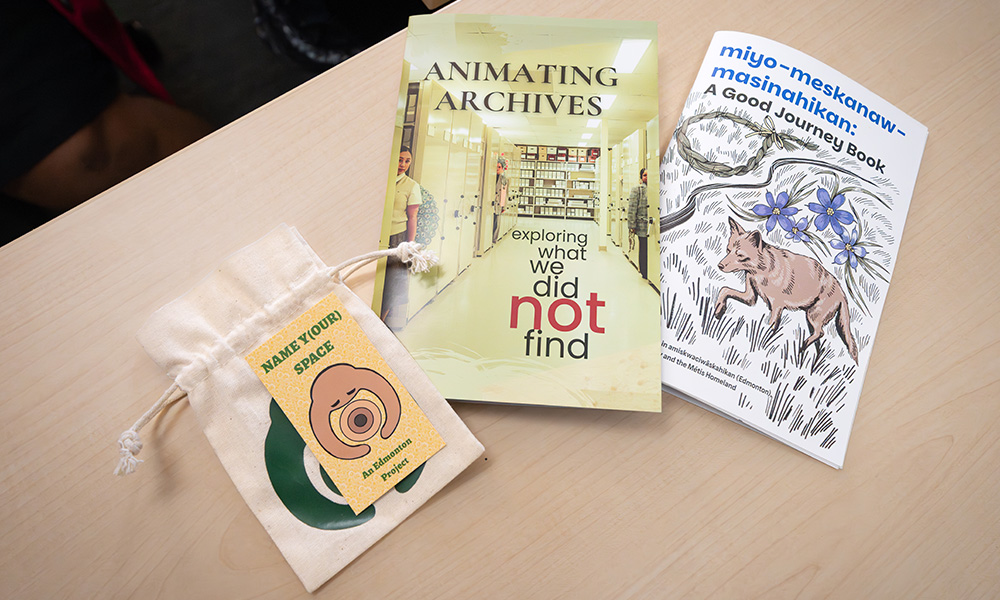
Dasmohaptra’s three favourite things in her office are all connected to research.
The first, pictured left, is student-led and grew out of a class project working with the naming committee. “Name Y(Our) Space” was created to generate more awareness and interest in what the committee does and what their work means.
“The students also thought about what it means to beautify a place and to make it safe,” Dasmohapatra explains. “What does it mean when we create spaces where a name can actually give identity and also comfort?”
The second project, “Animating Archives,” was a year in the making. Dasmohapatra and fellow researchers explored the Edmonton archives to find materials on the Asian diaspora experience in the city.
“It was all really racist and horrible. There was nothing else beyond that, nothing contemporary, nothing about the positive things that the South Asian community has done,” she says. “So we decided to take some materials and do a collective piece about the silence there.”
Dasmohapatra and her fellow researchers used their talents to create artwork, performance pieces and gather responses from across the country to add to their digital storytelling. They also produced a zine, pictured above. They presented at the C2U Expo hosted by MacEwan last spring, though the work is ongoing.
The third project was initially sparked by Dasmohapatra’s own background as a classically trained Indian dancer, which led her to collaborate with CanDance Network. When the opportunity arose to help host a national dance collective, Dasmohapatra and her students joined forces with the dance company to provide learning opportunities.
The three-day event featured land-based learning in Whitemud Park, and demonstrations of traditional Indigenous dances and songs in MacEwan’s Roundhouse. Dasmohapatra and her co-organizer created “miyo-meskanaw-masinahika, A Good Journey Book” – a resource guide about what they hoped attendees would take away from the experience.
“It’s a whole bunch of pieces on Treaty 6 Territory and what it means to be here,” says Dasmohapatra.
What does it mean to have your students and peers nominate you for this award?
“I’ve been a sessional, but to be a new, full-blown academic is really intense. I’m working on my doctorate in social sciences and getting this award is really fulfilling. The fact that my students and my faculty support me says a lot. I’m so grateful.”
 Nominate a faculty member