
VR goggles, AI and ChatGPT, immersive learning, human-patient simulators. Tech talk is ubiquitous in post-secondary classrooms.
Why does it fit so well here?
“In education, we have the space for students to explore complex issues and challenges,” says Jenn Danko, assistant professor in the Department of Design. “We bring in digital technology – and blend it with traditional technologies – to unpack things in ways that aren’t possible outside of the post-secondary system.”
At MacEwan, that looks like chemistry students visualizing molecules in 3D before a lab, social work students engaging in simulations of difficult conversations and nursing students entering virtual patient rooms where they can practice communication, clinical decision making and care planning.
Here, five profs take a look at high tech – and low tech – and where it fits into what they teach.
“Our spaces were very deliberately designed for simulation and immersive learning experiences,” says Dr. Jill Vihos, associate dean in the Faculty of Nursing. “MacEwan has led the way in simulation, best practices and professional development.”
Back in 2007, when the Robbins Health Learning Centre first opened, the Faculty of Nursing was leading the way with professional development workshops for faculty to design and implement simulations and to prepare students. Learning best practices for debriefing simulations with students, based on emerging research evidence, was an important part of these sessions.
“Simulation delivery was done very intentionally and aligned with evidence-based research to maximize student learning,” says Vihos.
Fast forward to now, and the gamut of simulation tech is even more comprehensive, including high-fidelity, artificially intelligent (AI) simulators and a range of virtual reality (VR) equipment and software.
“Simulation is immersive learning that really emulates clinical practice situations,” explains Dr. Vihos, who is also an assistant professor in the Department of Integrative Nursing Systems. “Practicing in a controlled environment before they transition into clinical practice really helps students synthesize their knowledge and apply it in low-risk scenarios.”
A student can practice technically challenging skills – like giving an injection – in a VR environment and then on a mannequin before practicing on a human. Their first go at technology happens on a VR headset, so that by the time they get to the lab, they’re already familiar with the real thing.
“We have safe places – controlled environments – where students can practice all of those skills before going into clinical,” says Dr. Emilene Reisdorfer, interim associate dean and associate professor in the Faculty of Nursing, who recalls practicing needle insertions during her own nursing education.
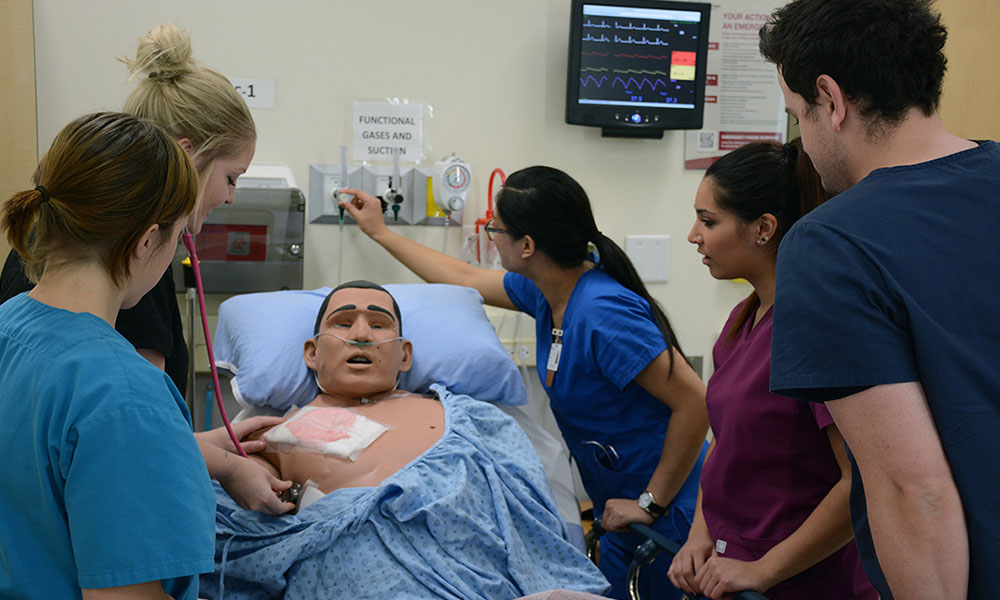
Simulation is taking an even bigger leap with AI. But the learning edge AI offers lies in developing what Dr. Vihos calls “soft skills.” In the context of health care, she explains, communication is about knowing how to gather information, ask the right questions and respond to challenging replies. In the lab, AI-powered mannequins help students hone these skills – adapting in real time to conversations with students and not from a pre-written script.
“Students learn how to receive data and process it, problem solve and apply knowledge – actually getting into the intervention that is needed in the situation,” says Dr. Vihos.
The other powerful part about simulations, adds Dr. Vihos, is how they help students collaborate – clarifying roles, working together to learn how to function in a team and resolving conflicts that might happen when they’re taking care of a patient.
“In a health-care environment, you don’t just provide care by yourself, you’re communicating with physicians, other nurses or other allied health professionals.”
Patient simulators can pick up when students miss certain points in the conversation and give students real-time reports outlining what they missed and when. The idea is that by the time they get to a real situation in a clinical setting, they’ve already made the mistakes and corrected them.
“Students aren’t just sitting there and receiving. They’re actively doing and developing muscle memory at the same time,” says Dr. Vihos.
Collaboration doesn’t end between student groups or students and simulators. Faculty members across the university create some interesting tech collaborations.
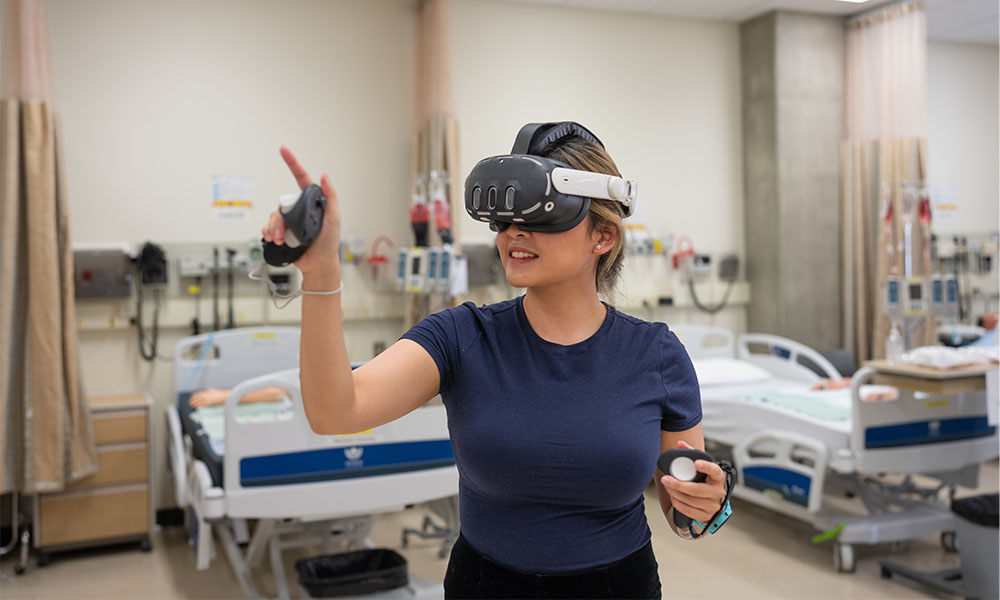
Take a project that came out of a casual conversation between assistant professor in nursing Melanie Neumeier and Dr. Sam Qorbani, associate professor in computer science, for example. It led to then-student Jehdi Aizon (Bachelor of Science ’25) creating an IV pump simulation, allowing first- and second-year students to practice before trying out their new skills. Understanding the technology from the simulation means that once students are in the lab, they focus on more challenging skills like eliminating air bubbles in the line.
 Read her story
“VR reduces the chance of making mistakes in the real environment,” says Dr. Qorbani, whose PhD thesis investigated improvements in student test scores when VR was part of their learning. “That is where our niche lies.”
Dr. Qorbani’s passion is contagious. He supervises a number of student researchers working on various VR projects – a simulation where social work students practice difficult conversations before starting a practicum and using immersive virtual reality to help chemistry students get a head start visualizing molecules instead of just reading from the textbook.
But it’s not simply immersion in your surroundings. Dr. Qorbani says that’s not enough.
“Interactive experiences create muscle memory and help students understand the concept. So that once they go into the actual environment, they’re not stressed out.”
“Once learners practice enough in that virtual environment, the time they have to spend on the actual machine is reduced and they’ll be more efficient.”
But not all scenarios work out. “At the end of the day, you might fail, like any other project. But you won’t know until you test it,” he says.
“You can write code for hours and hours and be happy with what you have done, but it means nothing unless you collaborate with someone who can help test your idea and see the impact.” His collaborations find him working with researchers at the University of Alberta, the University of Toronto, Carleton University and Toronto Metropolitan University on educational technology applications and immersive learning solutions.
Dr. Qorbani recalls his own time as a student, when a professor told him that good design creates possibilities – it’s a concept he now passes along to his students.
“But how do you measure a well-designed product?” asks Dr. Qorbani. “By the people who use it.”
That’s exactly the kind of language that you’ll hear from Jenn Danko and Dr. Isabelle Sperano, who teach in the Department of Design.
The two are currently working on a project with faculty in social work – along with student researchers – to create life-skills resources for youth transitioning out of government care.
Although Danko and Dr. Sperano are in a very tech-driven field, they agree with Dr. Qorbani, emphasizing that their work is less about the tool and more about the people who use it.
Research for their life-skills project includes focus groups with youth who have transitioned out of care and can help identify how these individuals access information. They learned that a combination of videos, written resources and a website will work best.
“The tech is not why we do something,” says Dr. Sperano, who is also the coordinator of the Digital Experience Design (DXD) pathway at MacEwan. “We do this because there's a problem. There are people who need help, but there are gaps. And maybe the solution is a website, but maybe it’s just better in-person service. We don’t really know until we start to work on the project and we start learning. Tech is one way to get there, but it’s not the only way.”
Clinical experience, for example, is something AI simply cannot replace. “The AI hasn’t been a nurse working on a floor before.”
It’s why Dr. Vihos says that professors remain such a critical piece of the learning equation. “Instructors are foundational to helping students connect the dots and push them further,” she says. “To ask questions like, ‘What are the resources for the patient when they get discharged from the hospital?’”
It’s in the debriefs that happen after a simulation, she explains, where instructors help students make sense of their experience.
That’s why the interdisciplinary nature of a university setting is crucial.
Whether in design, nursing or computer science, it always comes back to the students.
“We see design as an applied art and a social science. So the students see both aspects as well,” says Dr. Sperano. “There are so many opportunities that will be coming. I think we are in a good place.”