
When Elaine Alejandro was asked to choose a topic for an assignment in Gabriel Barrington-Moss’s NURS 272: Mental Health Nursing course, she knew it needed to be something she really cared about.
“I thought about my own experience of freezing up after a sexual assault and how, when I asked for help, people sometimes couldn’t understand why I froze,” explains the second-year Bachelor of Science in Nursing student. “That retraumatized me, led me to need more time to heal and to feel guilty about my response to the assault.”
Learning that she wasn’t alone – 70 per cent of sexual assault survivors experience a “freeze” response, known as tonic immobility, after sexual assault – made Alejandro realize the role nurses could play in stopping the cycle of retraumatization.
“This isn’t a rare occurrence, but rather a misunderstood one,” she explains. “In health-care settings, uninformed and often well-intentioned providers may inadvertently reinforce shame by using incorrect or stigmatizing language, asking intrusive or harmful questions, or failing to acknowledge that trauma responses are normal and adaptive reactions to distressing experiences.”
Alejandro set out to learn how to integrate trauma-informed principles of tonic immobility into her own nursing practice and to help others do the same.
The most powerful interventions, she found, involved a response that used three different prompts: normalizing, reframing and validating.
“Nurses can help survivors understand that tonic immobility is a common, automatic and biological response to extreme terror, that their response wasn’t a choice, but a reflex, and that feeling confused or upset about the responses makes perfect sense,” Alejandro explains. “Nurses can provide life-changing psychoeducation by following these prompts.”
The opportunity to help other survivors feel understood and seen is what stands out most to Alejandro, who extended her research beyond the confines of a single course to also examine how tonic immobility occurs, and why survivors often distrust health-care and other systems.
“I loved learning and exceeding the education expectations,” she says. “University is really what you make it, and this project showed me that there was a way for me to be my own educator.”
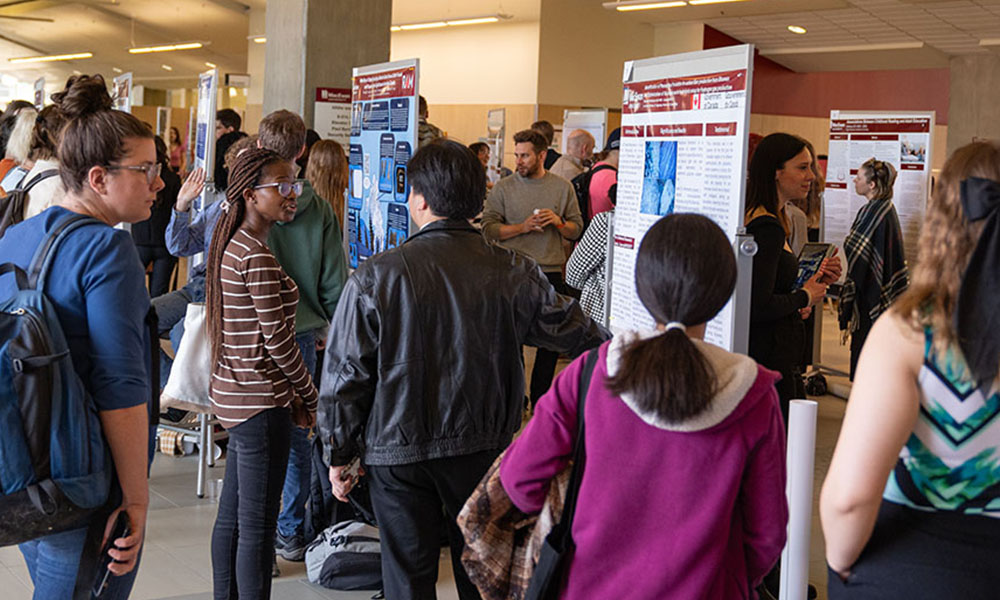
Alejandro received MacEwan’s 2026 Sexual Violence Student Research Award from the Office of Sexual Violence Prevention, Education and Response and the Office of Research Services, after presenting her research at an annual forum that accepts submissions of papers, projects and creative works.
“It means a lot to me, as a survivor, to help others be understood and seen,” she says. “When I told my mom about the award, she cried and told me that she was so proud that I was able to take something positive from one of the most negative experiences of my life.”

This student snapshot story is part of a series that showcases MacEwan students’ passion, experiences and accomplishments – inside and outside the classroom.
Know someone we should feature?
 RESEARCH PRIMER