When Etienna Moostoos-Lafferty was taking field notes for a course assignment as passenger on a drive in northern Alberta, she started to notice something beyond signage and roadkill. Many of the First Nations communities she passed through were divided by a major highway.
She told host Rea Pallay on a recent episode of the Office of Research Services’ Research Recast(ed) podcast that aside from devastating fire evidence and highway pollution, what really troubled Moostoos-Lafferty was the proximity of highways to First Nation communities. How do highways affect the way we engage in relationships? And as an educator, she wondered how highways might affect education.
Moostoos-Lafferty, an assistant professor in the Department of Early Learning and Curriculum Studies who holds a cross-appointment with kihêw waciston, began looking deeper. Over the years, she spent a lot of time on Highway 43. This summer, she spent a significant amount of time speaking to people in her home community in Sturgeon Lake Cree Nation.
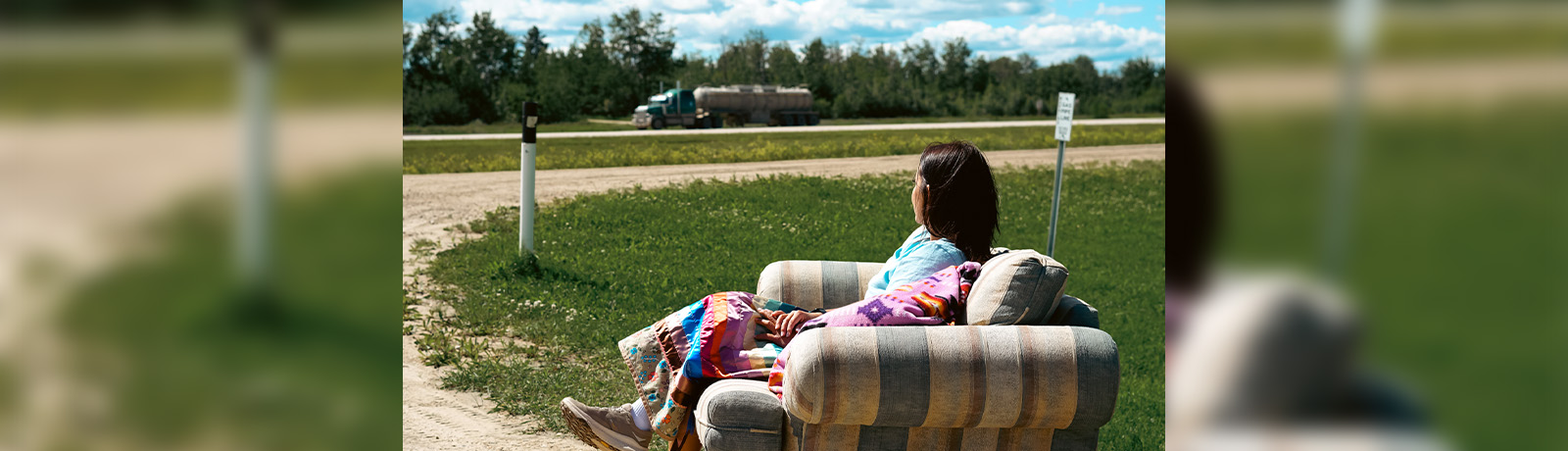
“I placed a couch near the highway and had what I called highway-couch conversations,” she says. “It was inspired by a really incredible man that has since passed. He was a member of our community, and that’s something he would do.”
A researcher in his own right, she says, he observed his surroundings day after day, interacting with people as they drove by waving or stopping to chat, and connected with the land.
During her research by the highway, many people from the community would drive up and ask questions. “I had 11 couch conversations. I probably had 20 or more just leaning up against someone’s car explaining what I was up to.”
She found that people’s opinions on the highway itself were mixed. Some enjoy the connections it allows for, while others see the separation it creates between areas of the community. Moostoos-Lafferty notes that the highway affects relationships, how people connect to resources and even how youth participate in extracurricular activities.
“I’m trying to create stories of positionality – the positionality of the man on the couch and my own positionality as a liminal kin, as someone going back and forth as a child from urban to rural,” she says. “I hope that what this research will do is prompt educators to think about their own proximity to highways and how that shapes the way that they engage in relationships, the way that they engage with knowledge or the way they engage with Indigenous people altogether.
Watch the full episode to hear more about INDG 260 and INDG 460 – courses on treaties Moostoos-Lafferty is creating here at MacEwan – and how her work on Highway 43 applies to Canada as a whole: