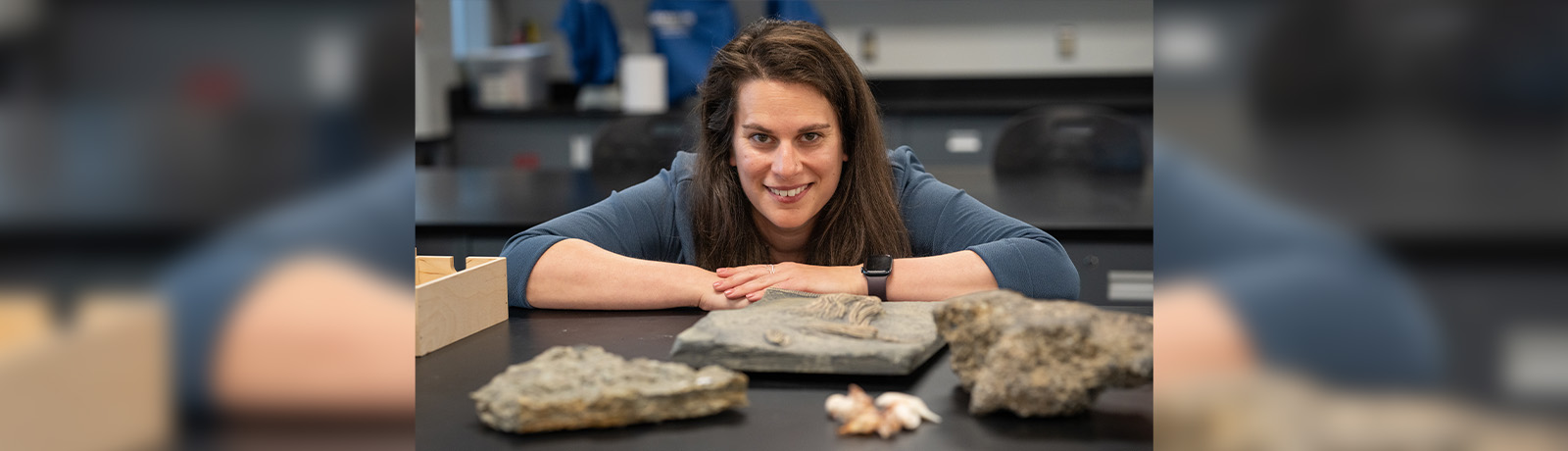
Dr. Carolyn Furlong put rocks and fossils in her office before anything else. “When students come by and ask me questions, I have samples available to show them while we talk through different concepts.”
The 2026 Early Career Teaching Excellence Award recipient says that the geological specimens aren’t just a teaching instrument, they’re reminders of the places she’s travelled and the things she’s accomplished – including making her mark on the Canadian landscape. While working on her PhD, Dr. Furlong studied a specific unit of rock with unique characteristics within the subsurface of northern BC. “My project was to describe this interval of rock for sedimentological and paleontological characteristics, map it out to see its distribution and then, finally, name it because the characteristics were unlike the rock interval above and below,” she says. “It’s named the Sunset Prairie Formation, after the hamlet of Sunset Prairie in B.C., and is about 245 million years old.”
And the assistant professor in the Department of Physical Sciences uses both her vast expertise and local, familiar examples to really cement the concepts she teaches in her classes. In her introduction to physical sciences course, she points just south of campus for tangible evidence of what’s being discussed in class.
“You can look outside and see the river valley, which is shaped by the river moving over time and eroding the edges away. These are concepts we talk about in class that students can see in their real lives – making those connections is really fun.”
Welcome to the lab
Dr. Furlong’s office hours are a time to ask questions, from specific assignments to broad questions about her field of study.
“Usually the conversation turns into something I didn’t expect,” she says. “They could be wondering about their career path, or a problem they’re having in my class, or in a different earth science class, or just want to dive deeper into the topics that they’re most interested in.”
In an earth sciences lab in Building 5, she showed us some of the teaching tools she uses to help those students get answers to their questions.
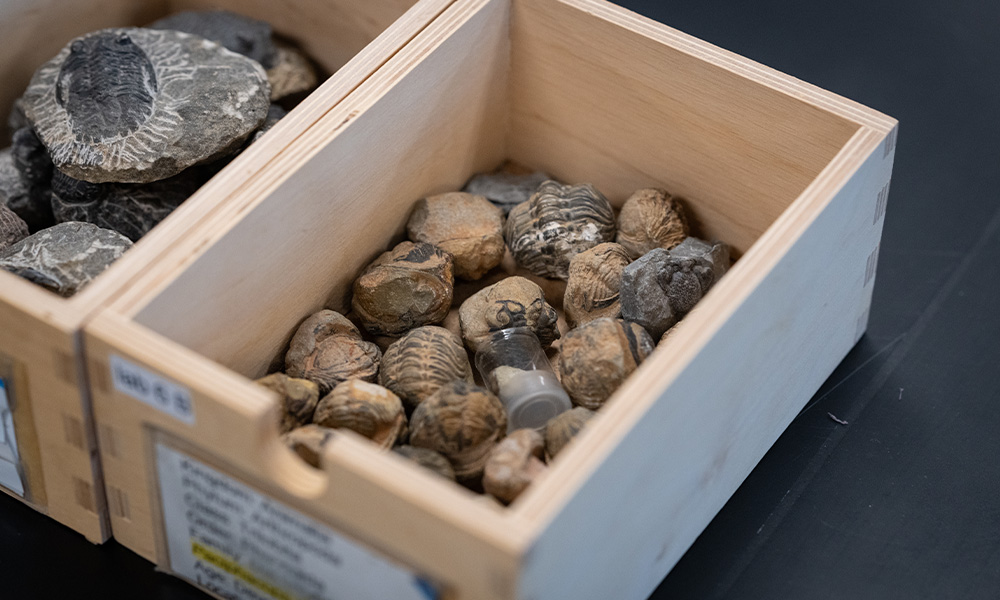
One fossil that Dr. Furlong mentions is the trilobite – a bug-like arthropod that lived along the sea floor. These particular fossils show the trilobites curled up into a ball. “Think of how an armadillo rolls up when it’s being attacked – trilobites evolved a mechanism to start to roll up like the armadillo, so they wouldn’t be attacked and eaten easily. These ones are really cool because you get to see a snapshot in time of what the organism was going through.”
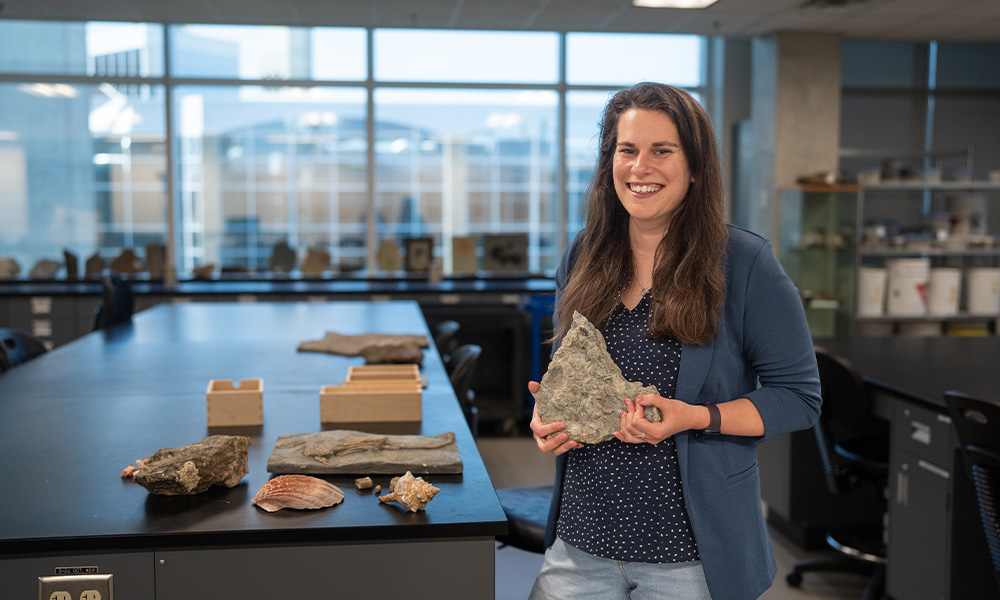
She also brought out some rock samples, like the one in her hands in the photo. “This is a limestone, which is made up of the skeletons of ancient marine organisms. You can see things like corals, bryozoa and shells of brachiopods. The cool thing about sedimentary rocks is that they tell you about the environmental conditions and organisms that lived in that area hundreds of thousands of years ago. The rocks hold clues about past conditions, how they have changed over time and how to predict what might happen in the future.”
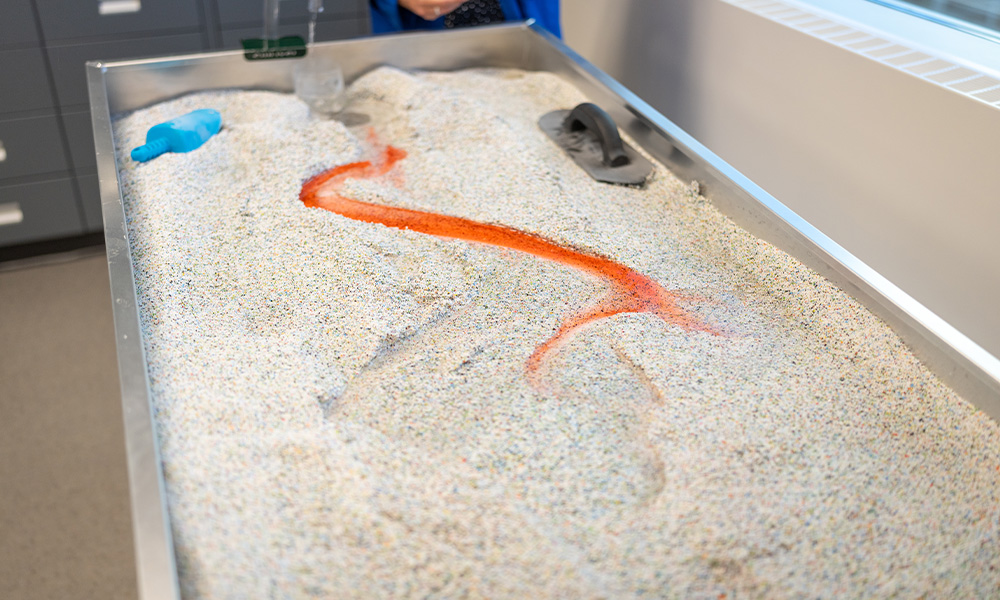
Dr. Furlong also uses a stream table in her teaching, which mimics how constantly flowing water – like a river – affects the earth. “The river moves and erodes and deposits in different places and starts to create these S-shapes like we see in the river valley,” she says. “When we look at the outside world, a lot of the processes seem static. In our river valley, we see the curves, and it looks like it’s just been that way forever. But by using a stream table, we can see how dynamic the river actually is.”
What does receiving the Early Career Teaching Excellence Award mean to you?
“I’ve had lots of mentors and teachers throughout my life who have given me tools to learn, and so it’s an honour to have my colleagues and students nominate me for this award. To me, it shows that I’m influencing students in a positive way, creating a learning environment that students enjoy and creating this environment for future earth scientists – for the next generation to come.”
 Nominate a faculty member