
DEPARTMENT of HUMANITIES
Courses
The humanities discipline stretches from history and classics to philosophy, literature and language. What unites all of these disciplines is a commitment to a broad-minded cultural education.
Our department offers courses in the disciplines listed below. For individual course descriptions, follow the links to MacEwan University’s Academic Calendar. Not all courses are available each term. Courses must be numbered 100 and above to be used to fulfill degree requirements.
The department offers language courses that may be used to fulfill literacy breadth requirements for the Bachelor of Arts. Before you enrol in a language course, consult placement guidelines.
About breadth requirements
Students from all programs have the option of taking courses from the Department of Humanities to fill their breadth requirements. You can choose from courses in history, philosophy, classics, humanities and languages. Want to learn a new language? You have several to choose from. Fascinated by Greek and Roman mythology? The Classics might be what you're looking for. Interested in reading and studying some of the world's greatest books in their entirety? Then HUMN courses are the way to go. Speak to our discipline advisors to find out which humanities discipline is the right fit for you.
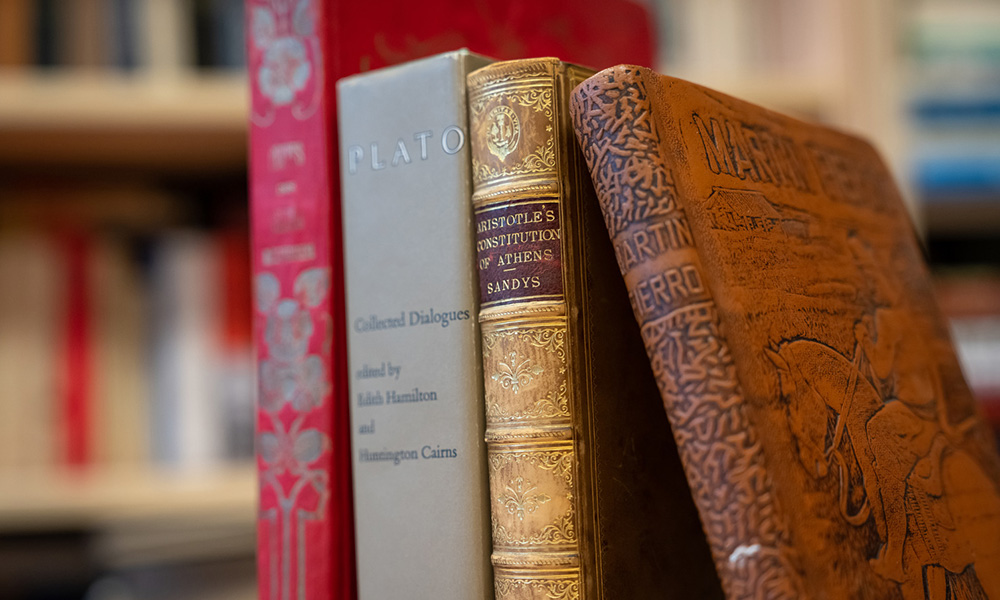
Want to read the world's great books? Take a HUMN course.
In the preface to his book Culture and Anarchy, the English author Matthew Arnold described a humanities education as "getting to know, on all the matters which most concern us, the best which has been thought and said in the world." Through our interdisciplinary HUMN courses, you do just that, reading classic texts from around the globe in their entirety and taking part in constructive conversations about them.
Fall 2026
Course: CLAS 333: Topics in Ancient Religion | Isis and Sarapis in the Graeco-Roman World
Term: Fall 2026
Session: AS01
Instructor: Dr. Matt Gibbs
This course examines the Egyptian deities Isis and Sarapis, their cult, their influence and their place in Graeco-Roman cultures and societies. From the Renaissance onwards, Isis and Sarapis have been—directly or indirectly—central to the study of Egyptian influences and artifacts found in the Greek and Roman worlds, and as such, provide an ideal way in which to understand the movement and syncretic nature of ancient religions across this region. In the broader context, the study of these religions also allows us to analyze the external influences on a fundamental facet of Graeco-Roman cultures and societies. Using archaeological, documentary and literary evidence, this course examines the activities, membership and mythology behind these cults while considering their geographic and chronological spread and influence throughout the Mediterranean region in art, architecture and literature.
Prerequisites: A minimum grade of C- in one of CLAS 233, CLAS 270 or CLAS 271
Permission Required: No
Course: FREN 370: Topics in Francophone Culture | Francophone Cultures through Film
Term: Fall 2026
Session: AS01
Instructor: Dr. Suzanne Hayman
This course focuses on the study of different cultures within the Francophone world through the analysis of film. From a perspective that is both geographical and thematic, this course explores, through film, several regions of the Francophone world (North and Sub-Saharan Africa, the Caribbean, Southeast Asia, Québec and Europe) as well as issues that characterize the French-speaking world (colonialism, independence, diversity, immigration, co-existence, women’s issues, etc.) to ultimately broaden and deepen one’s understanding of la francophonie. This course is conducted in French.
Prerequisites: A minimum grade of C- in FREN 298 or any 300-level FREN course
Permission Required: No
Course: HIST 411: Topics in Medieval and Early Modern British History | Households, Shopping, Material Culture and Consumption in Early Modern Britain
Term: Fall 2026
Session: AS01
Instructor: Dr. Rob Falconer
Coffee and chocolate; silks and cotton; shoes, spices, furnishings and food—the demand for such commodities at nearly every social level reflected shifting attitudes toward consumption and evolving household priorities in the seventeenth and eighteenth centuries. Between 1600 and 1800, the British Isles witnessed a significant expansion in the acquisition of luxury goods. The historian Jan de Vries has argued that the growing availability of new consumer products in England and Scotland from the seventeenth century stimulated increased “family labour” in pursuit of expanded “consumption possibilities.” Drawing on what de Vries terms the “Industrious Revolution” as a conceptual framework, this course examines conspicuous consumption, shopping practices, labour and leisure, household economies, material culture, commercial expansion and related dimensions of early modern social and cultural history. As Craig Muldrew has observed, “[B]efore the widespread harnessing of machine energy based on carbon fuel, almost all labour had to be done by men and animals. Bread and beer were the petrol of this world.”
Prerequisites: A minimum grade of C- in 9 credits of 200- or 300-level HIST courses
Permission Required: No
Course: HIST 476: Topics: History of Religion | Religion, Refugees & Migrants
Term: Fall 2026
Session: AS01
Instructor: Dr. Sean Hannan
It would be hard to deny that the migrant crisis is one of the defining topics in today’s political discourse. But it would be equally impossible to make sense of that crisis without digging deeper into the history of human migration. Our goal is to study how and why refugees and migrants traversed the ancient world due to factors ranging from religion to politics and economics. And while our primary focus is on migrations around the Mediterranean during the ancient and medieval periods, students are invited to explore how those pre-modern exemplars set the stage for how we continue to confront migrant crises around the globe today.
Prerequisites: A minimum grade of C- in 9 credits of 200- or 300-level HIST, including at least 3 credits from HIST 204, HIST 205, HIST 304 or HIST 308
Permission Required: No
Course: HIST 490: Topics in Social History | Modern Queer Europe
Term: Fall 2026
Session: AS01
Instructor: Dr. Alessio Ponzio
This course explores the construction, expressions and politics of queer sexual desire in modern Europe. It investigates how sexuality has become central to questions of identity in modern European societies. The readings for the course are drawn from sexological texts, political writings and recent scholarship produced by both historians and theorists of sexuality. Film screenings further illuminate key debates and cultural expressions central to the course themes. This course not only offers a chronological history of modern queer Europe, but also interrogates the meanings of the term ‘queer’ and explore what queer historical practices look like or should look like. We not only trace the history of those individuals who would claim to occupy various categories of identity, but also explore how those identity categories have been brought into existence.
Prerequisites: A minimum grade of C- in 9 credits of 200- or 300-level HIST courses
Permission Required: No
Course: PHIL 402: Topics in History of Philosophy | The Philosophy of Religion of Simone Weil
Term: Fall 2026
Session: AS01
Instructor: Dr. Cyrus Panjvani
In this course, students study the philosophy of religion of Simone Weil. In addition to being a philosopher and prolific writer, Weil was an activist committed to several compassionate endeavours and has been characterized as a mystic. The relation between her life and thought is a point of focus in the course. Students read primary and secondary source materials, are expected to participate regularly, give presentations and complete a major paper.
Prerequisites: A minimum grade of C- in 9 credits of 200- or 300-level PHIL, with at least 3 of those credits at the 300-level
Permission Required: No
Course: PHIL 403: Topics in Moral Philosophy | Heidegger and Aristotle
Term: Fall 2026
Session: AS01
Instructor: Dr. Alain Beauclair
In this course, we read Being and Time by Martin Heidegger alongside Aristotle’s Nicomachean Ethics.
Prerequisites: A minimum grade of C- in 9 credits of 200- or 300-level PHIL, with a least 3 of those credits at the 300-level
Permission Required: No
Course: SPAN 370: Topics in Hispanic Cultures | Voices and Visions of the Hispanic World
Term: Fall 2026
Session: AS01
Instructor: Dr. Alba Devo Colis
This course explores the relationship between art, culture and society in Spain and Latin America. Students engage with influential and emerging voices through a variety of authentic cultural materials, including photographs, short films, short stories and other visual and textual sources. The course emphasizes cultural differences and shared experiences across the Hispanic world while supporting the development of Spanish grammar in context. Special attention is given to creative and reflective activities connected to students’ everyday lives, personal experiences and the world around them.
Prerequisites: A minimum grade of C- in SPAN 230 or any 300-level SPAN course
Permission Required: No
Winter 2027
Course: CLAS 353: Topics in Classical Archaeology | Roman Britain
Term: Winter 2027
Session: AS01
Instructor: Dr. Kelsey Koon
Britain was both one of the last provinces to be added to the Empire and one of the furthest away from Rome. But what did becoming part of the Roman Empire mean for the average inhabitant of Britain? Did it matter? How did the presence of Roman authority on the island change life in Britain, and what did this mean for the island’s future? This course examines the history and archaeology of Britain during the Roman period through guided reading, discussion and critical analysis of the archaeological and historical record.
Prerequisites: A minimum grade of C- in CLAS 208, CLAS 209, CLAS 210, CLAS 250, CLAS 252, CLAS 255, CLAS 280, or consent of the department
Permission Required: No
Course: FREN 365: Topics in Francophone Literature | L'Écriture Migrante
Term: Winter 2027
Session: AS01
Instructor: Dr. Kyeongmi Kim-Bernard
This course, taught in French, examines French migrant writings published since 1980 in Canada and France. Students question the confrontation and reconciliation of self and otherness, as well as the disorientation and re-orientation of identities and territories by analyzing the fiction and non-fiction writings of French migrant writers such as Dany Laferrière, Dai Sijie, Kim Thúy and Ying Chen.
Prerequisites: A minimum grade of C- in three credits of 200- or 300-level ENGL, not including ENGL 205, ENGL 207, ENGL 211, or ENGL 297
Permission Required: No
Course: HIST 301: Topics in World History | Health, Medicine, and Society, 1800-Present
Term: Winter 2027
Session: AS01
Instructor: Dr. Caroline Lieffers
This course examines histories of medicine and health, concentrating on North America and Europe from about 1800 to the present. Themes include the roles of different health practitioners, Indigenous medical experiences, the emergence of germ theory, eugenics, contraception and childbirth, debates in the history of psychiatry, the history of bioethics and the rise of global health.
Prerequisites: A minimum grade of C- in any 100- or 200-level HIST course
Permission Required: No
Course: HIST 410: Topics in European History | The Napoleonic Empire
Term: Winter 2027
Session: AS01
Instructor: Dr. Kelly Summers
This course examines the rise and fall of one of history’s archetypal “great men.” Napoleon Bonaparte remains a controversial figure whose ingenuity, charisma and ambition transformed European politics and global warfare. From Corsica and Egypt to the Caribbean and Russia, this seminar explores Napoleon’s meteoric career and enduring impact on France and the world. A product of the French Revolution, Napoleon entrenched and exported certain revolutionary innovations while gutting others. He pledged to restore peace and prosperity, only to embroil Europe and its colonies in a vicious cycle of total war that claimed millions of lives. By applying the tools of political, military, art and gender history to Napoleon’s paradoxical record, this seminar separates the man and his legacy from his carefully cultivated mythology.
Prerequisites: A minimum grade of C- in 9 credits of 200- or 300-level HIST, including one of HIST 205, HIST 209, or HIST 210
Permission Required: No
Course: HIST 442: Topics Imperialism/Colonialism | Imperial Travel: Cultural Encounter and Global Mobility
Term: Winter 2027
Session: AS01
Instructor: Aidan Forth
This semester explores the history of imperial travel through the lens of “contact zones,” spaces in which imperial actors and local peoples came into close physical and social proximity and, often, into relationships of mutual—if frequently unequal—interdependence. Students will consider how movement was mediated by race, gender, class, and material conditions, and how travelers represented indigenous cultures, societies, and landscapes. The course also considers how nineteenth-century technologies such as steamships, railways, and telegraphs reshaped imperial mobility and experiences of cultural encounter. Readings combine theoretical and historical scholarship on empire and travel with primary sources, including diaries, guidebooks, and travel narratives.
Prerequisites: Minimum grade of C- in 9 credits of 200- or 300-level HIST courses.
Permission Required: No
Course: HIST 442: Topics Imperialism/Colonialism | Imperial Travel: Cultural Encounter and Global Mobility
Term: Winter 2027
Session: AS01
Instructor: Dr. Katie-Marie McNeill
In this seminar-based course, students discuss, critique, and analyze the history of incarceration in Canada in the nineteenth and twentieth centuries with a focus on federal prisons. Students will engage with primary and secondary sources on the establishment of Canadian prisons, daily life in prisons, and prisoners’ experiences of incarceration. Students also prepare a major research paper on an issue related to Canadian prison history.
Prerequisites: A minimum grade of C- in 9 credits of 200- or 300-level HIST courses.
Permission Required: No
Course: PHIL 402: Topics in History of Phil | Berkeley's Idealism
Term: Winter 2027
Session: AS01
Instructor: Susan Mills
What is “out there” in the material world? How can we know it? What is it really like? These well-worn philosophical questions share a certain assumption, namely, that there is a material world separate from our minds and ideas. The philosophical position of idealism, however, rejects that assumption and tears down the mind-world distinction that we commonly accept as true. Idealism, in brief, is the theory that only minds and ideas exist and the objects you sense are nothing other than sensations in your mind. One of the most famous defenders of idealism was George Berkeley (1685-1754), an Irish philosopher of the early modern period and a critic of many other philosophers of that time. In this seminar, we will conduct a close reading Berkeley’s lively, wonderous, and thought-disrupting Three Dialogues between Hylas and Philonous in order to understand, appreciate, and critically assess his philosophical stance that to be is to be perceived. Our study will be enhanced by selections from Berkeley’s A Treatise concerning the Principles of Human Knowledge as well a variety of recent secondary source scholarly articles about Berkeley’s philosophy. Regular seminar attendance is required, and all seminar participants will be responsible for completing reading, writing, and presentation assignments.
Prerequisites: A minimum grade of C- in 9 credits of 200- or 300-level PHIL, with at least 3 of those credits at the 300-level.
Permission Required: No

What does it mean to be human?
In Humanities 101: Humanism, you consider what it means to be human across different cultures and at different points in history. How do people relate to one another? What do they think is important? The following authors may be required reading in this course: Cicero, Voltaire, Gabriel García Márquez and Plato.