Cities are full of incredible opportunities – and challenges. MacEwan students are asking questions to address problems as straightforward as licensing your pet and as complex as food security, houselessness and how a city becomes a community.
It’s research that extends beyond the walls of MacEwan – all the way to City Hall.
Earlier this year, Mayor Andrew Knack and City Councillor Aaron Paquette were part of Dr. Brendan Boyd’s class, which tackled City of Edmonton policy issues. Councillors Michael Janz and Jon Morgan also joined Paquette in April for MacEwan’s largest-ever Student Research Day.
Read on to learn about some of the problems MacEwan students have been dreaming up solutions to.

What politicians say about a public service matters
Recent grad Jennifer Hart, Bachelor of Arts '26, wrote a research paper as part of a seminar with Dr. Brendan Boyd, associate professor in the Department of Anthropology, Economics and Political Science, that was inspired by the distinct shift in morale she witnessed while working with the Alberta RCMP, following growing public criticism from politicians toward the institution.
“I’ve always been interested in how language shapes the way we understand institutions and the people who work in them,” she says. “This personal experience made me curious about what sustained negative messaging actually does to the people on the receiving end.”
Public servants don’t often get a chance to speak in these conversations, she says, so her research focused on interviews to centre their voices.
The results, she says, showed a quiet erosion. “The damage isn’t loud or sudden. It’s quiet, and it builds. It doesn’t just shape public opinion – it shapes how the people doing that work see themselves and their contribution.”
Some people, for example, even stopped disclosing where they work in social situations.
Though her sample size was small, Hart believes the study could easily extend beyond the RCMP to other fields, including health care.

Food insecurity and the loss of traditional food systems among Indigenous families in Edmonton
“Food is not only about nutrition. It is also about culture, identity, relationships and belonging, and community well-being,” says Caoilfionn Gardiner, a Bachelor of Early Childhood Curriculum Studies student whose curiosity about food insecurity inspired a literature review.
Working with Dr. Ozlem Cankana, Gardiner looked at how colonial history, socioeconomic inequalities and barriers to culturally relevant food have led to the loss of traditional food practices – hunting, fishing and food sharing – and how these factors contribute to food insecurity.
And because food insecurity can affect participation in early learning environments, Gardiner says this project challenged her to think beyond statistics and really consider people’s lived experiences while reflecting on responsibilities connected to Truth and Reconciliation.
“Community organizations can support families through culturally grounded programming that restores traditional knowledge and strengthens community connections,” she says. “As a future early childhood educator, I have a responsibility not only to support children in the childcare but also to advocate for equity, belonging and stronger relationships with families and communities.”

How can public policy create a safe and welcoming downtown?
For their final project in Dr. Brendan Boyd's political science class – POLS 344 Fundamentals of Policy Analysis – Bachelor of Arts students Quentin Gallagher, Sahijpal Kambo, Madison Martell, Francheska Monzones and Amanda Patenaude looked at factors that can make a downtown feel unsafe or unwelcoming.
“We found that the cleanliness of downtown was a key part. When it’s clean, people feel more welcomed,” says group member Madison Martell, a Bachelor of Arts student. Other factors include a previous negative experience and visibility of people who are unhoused.
“Downtown Edmonton has a lot of fun, vibrant places that people do not feel safe going to,” says Martell.
The group looked at cities similar to Edmonton in population or weather – Denver, Salt Lake City and Whitecourt – to examine their efforts to improve downtown vibrancy.
They focused on strategies tied to cleanliness and bringing people downtown, and adapted them for Edmonton before presenting them to City Council.
Their recommended strategy mirrors the Community Clean Up grant program in Whitecourt, which provides funds to non-profit organizations that assemble groups of volunteers to clean an area.

Building a downtown that everyone can call “home”
Political science students Feben Melese, Megan Woods and Giancarlo Zenari came together as a group to ask what would make downtown not just a desirable place to work, but also a place people want to play and live.
The group says a key solution is to take steps to increase resident diversity and encourage more long-term residents.
“By expanding housing availability and affordability to be inclusive for families, you increase the likelihood of achieving a long-term residential base, decrease cost-of-living and contribute to a more vibrant downtown core,” says Megan Woods, who is completing a Bachelor of Arts.
As part of a group project in Dr. Brendan Boyd’s political science class, the students examined case studies and found an alternative that was successful in a few mid-sized American cities: encourage private investment from public revenue sources.
Even in some seemingly lost-cause cities, Woods explains, encouraging private investment worked when offered through long-term, forgivable loan programs and matching of public funds.
“By requiring goal-oriented projects to have private backers to access public funds, private investment in the downtown sector increased.”
And those projects can be incredibly significant for revitalizing a downtown.
“As people continue to see downtown as an economic hub, they will only live there if it conveniences them,” says Woods. “Focusing on downtown as home, we explored how to make rent more affordable, how to encourage families to move downtown and how to make downtown more appealing as a place to live.”

Government health policy and the impact on citizens
As part of a panel on global perspectives in urban wellness, political science major Aleace Moom examined the long-term effects of economic policies on public health and inequality.
Working with Dr. Marielle Papin, an assistant professor in the Department of Anthropology, Economics and Political Science and a Canada Research Chair (Tier II) in Urban Wellness, Moom’s research focused on structural adjustment policies (SAPs).
SAPs, economic policies, implemented through the World Bank and International Monetary Fund as conditions for loans to developing countries affected by the oil shocks and rising global interest rates from the late 1970s, saw countries to spend less on public services because international lenders – as a condition for financial rescue – required budget cuts and conservative spending. As a result, says Moom, people in affected countries had a harder time getting the social support and health care they needed – especially in cities, where access can vary greatly between communities.
She says that decreased spending has impacted the health of citizens for generations.
“Understanding these impacts is important for creating equality and healthier cities in the future,” says Moom. “Health equity is influenced by much more than health care alone. Political and economic decisions – even those made decades ago – can still affect people’s quality of life today.”
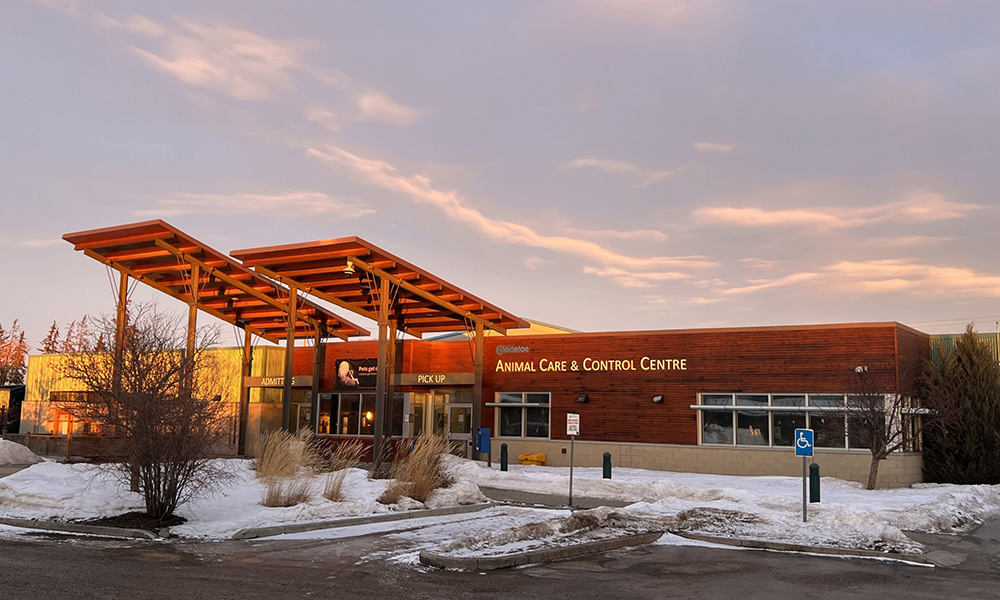
Redesigning the City of Edmonton’s pet licensing service
In a 400-level service design course with Dr. Isabelle Sperano, students in the Bachelor of Design program work alongside a community partner that’s facing a real problem.
For students Raquel Callele, Ella Jane Eresmas, Kelsey Kendrick and Cadence Mutch, that problem was finding creative solutions to the City of Edmonton's Animal Care and Control Centre (ACCC).
Pet owners are required by law to license their animals, but through preliminary research, the group found that acquiring a license can be challenging if you don’t have internet access, if English is not your first language, or if you have financial or transportation barriers.
The group felt that the gap between ‘everyone must license their pet’ and ‘here’s how you actually do it’ was a genuinely worthwhile design problem to work on.
So, they focused their proposed design solution on an potential new service experience in a way that fits within people’s lives – self-serve kiosks at Edmonton Public Library (EPL) branches.
Their design would allow people to license their pet close to home, in multiple languages and text sizes, and with a dignified pathway for people who qualify for reduced fees. They group also included a reference guide for EPL staff so they would feel confident supporting people who need help.
The students believe that accessibility is about whether a service actually fits into the way people live.

Confirming urban heat island effects using trained urban and rural temperature models
The urban heat island (UHI) effect – where urban areas see significantly higher temperatures than rural ones – can be seen increasing across Canadian cities.
“Cities are often warmer than nearby rural areas because roads, buildings and pavement absorb and hold heat,” says Bachelor of Science student Kevin Tran. Tran worked and fellow student Osman Jime worked with Dr. Wanhua Su, an associate professor in the Department of Mathematics and Statistics, to see if they could predict the magnitude of the UHI effect based on – or proportional to – the degree of urbanization in Edmonton.
“During heat waves, this extra warming can increase the risk of heat exhaustion, dehydration and heat-related illnesses, especially for vulnerable groups such as older adults, children and people without access to cooling,” says Tran.
Jime, who is in computer science, and Tran, an applied statistics student, used machine learning models to study weather data collected every hour over the past 10 years from different locations around Edmonton.
While summer effects were easier to use for prediction, the models weren’t accurate enough to account for winters in Edmonton due to extreme snowfall and snow cover. They say that models may need to be separately trained for each season to be more accurate predictors.
For them, that effort will be worth it for future generations.
“If we don’t address these issues and act on them, things will only get worse,” says Tran. “We don’t want to introduce future generations to a more difficult life. They should be easier and better.”

Illuminating modernism: The Canadian National Railway sign and mid-century design in Edmonton
Bachelor of Design students David Gaina, Danaca Neilson and Irene Nibi chose a significant artifact – a neon Canadian National Railway sign from the 1950s – when setting out to do research into Edmonton’s design history.
They traced the genealogy of the sign under the supervision of Danijela Zutic, an assistant professor in the Department of Design. In their final presentation – which included an in-situ vodcast with the sign in its current home at the Edmonton Neon Sign Museum – they explain how the sign is a significant artifact in Edmonton’s mid-century design history.
“The sign represents more than just a business advertisement. It reflects mid-century modernism, postwar progress and changing ideas of Canadian identity,” says Danaca Neilson.
The bold neon design, the students say, also represents technological growth and the professionalization of the graphic design field within Canada at the time.
“In this way, it shows how Canadian identity was also changing to include not only ideas of geography and nation building, but also modernity, technology, consumer culture and design,” says Neilson.
And in a city that is often overlooked in conversations about design, this sign – and others like it – can illuminate how Edmonton fits into Canada’s design history.
“This experience changed how we look at cities. We now notice the stories around us in everyday design.”
